Friday, May 17, 2013

Tao's Tweet Bag - Pertinent Questions, Flippant Answers

Well, hello chums, and welcome to the inaugural Tweet Bag of the 2013 season. Has it really taken this long into the schedule to churn out one of these posts?

Well, yes...but consider the toxicity of the conversation over the past few weeks, and you'll understand why this semi-regular post was delayed until the team managed to string together a couple of wins. I assume you'll understand. Friendsies?

Okay, on with your questions:

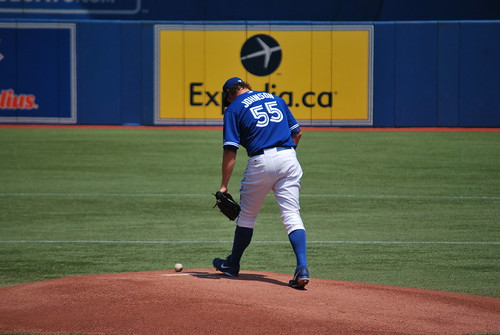
This question has been asked many times in recent weeks, and I tend to slough it off out of hand. I understand that there is the temptation to look at Josh Johnson like a dented can of soup on which we might be able to get a snazzy discount, but is it really worth it? Who likes dented soup?

But since you asked nicely, allow me to expand.

Firstly, it should be said that we don't really know what to make of Josh Johnson's injury because he's fully mired in it at this time. The moment of truth will come when he returns - whenever that happens - when we get to see how he looks when he's back to something resembling passable health.

If Josh Johnson returns and he's good, then you should probably kiss him goodbye. The Jays have a lot of money for the ensuing years already owed, and Johnson will be looking for more years than a reasonable team should give him. Which won't stop some damn fool team from handing him a contract for too much money and too many years.

There is a scenario where Josh Johnson misses a long stretch this season - maybe well past the point where he'd be tradeable -  where the Jays could make him a qualifying offer for one year. And if that were to come to pass and he accepted, then we can recycle this answer a year from now.

Onward!
You know, you could have asked "Who's better?" That might have been nice.

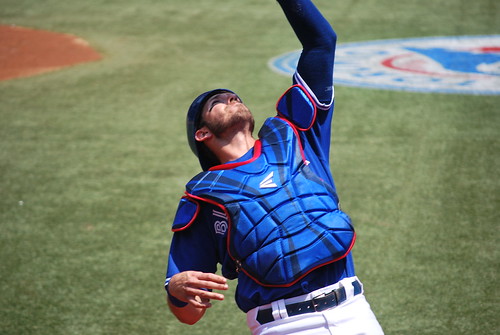
But since you asked: I tend to be focused on strikeout and walk rates when evaluating players lately, and neither JPA nor Colby are especially flattered by those numbers. JPA has struck out in a third (literally, 33.3%) of his at bats, while Colby has whiffed in an astonishing 40.7% of his at bats.

Colby has managed to convert some deep counts into bases on balls, walking in 8.6% of his trips to the plate. At the same time, Arencibia has walked twice. Two times. One time in the second game of the season, and then one other time against Baltimore. But in his last 20 games, he has not let a pitcher offer him a free pass.

Maybe he's just in a hurry to get back to the dugout to put his catching gear back on.

Yes, JPA has the second best isolated power on the Jays at the moment (.257), but Colby isn't far behind (.190), and offers vastly superior defense at a premium position. So I'll say Colby. Dang.

May I have another?

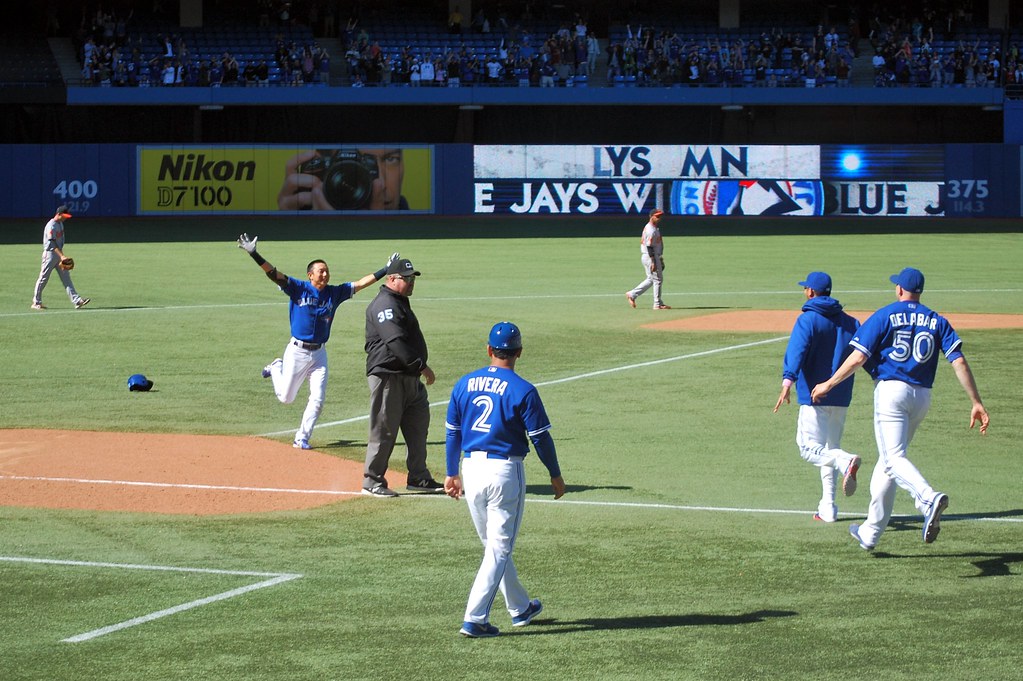
I understand that Kawasaki is an endearing player, and that his various antics and rituals have led to a streak of genuine affection from a certain portion of the fanbase. People dig plucky dudes.

Moreover, there are aspects of Kawasaki's game which were lacking in the Jays' lineup early on. This includes the ability to draw a walk, of which he has 11, or nine more than JPA in less than half the plate appearances. He also has the ability to get his bat on the ball, as evidenced by a stupendous 93.2% contact rate (4th in MLB among players with 80 or more PAs).

The biggest problem, though, is that Kawasaki doesn't hit the ball hard. At all. His .279 slugging percentage lags far behind his .337 OBP, and while he's managed to swipe five bags and only get caught once, there are limits to how productive you can be slapping the ball weakly around the field.

I'm also not a huge proponent of his defensive skills, though he plays short well enough to get by.

My suspicion is that once José Reyes returns, we won't miss Kawasaki's outsized personality that much.

A few quick ones to close us out...
I really like Robinson Cano, but know this: There is no amount of money that the Jays could offer Robinson Cano that the Yankees would not match. The only team that I could envision stealing Cano away is the Dodgers, but even they have their limits.
Maybe one more start. Or two. But probably not. He's walked between the raindrops in his first two starts. Though throwing strikes is always appreciated.

I think Rogers would have to lean on the Argos to find another place to play. It's an open question as to whether if that's something they really want, or if the 10-12 dates per year are worth enough to Rogers to tolerate the inconvenience. My guess is that the successful Grey Cup might have softened their resolve to get the Argos out, if that was even on their agenda.

And that's about what we can squeeze in for today. Thanks for the questions, and apologies to those whose questions were too smart for me to answer with some diminished capacity today. Cheers, and enjoy your long weekend.

Monday, May 13, 2013

Glimmering Slivers of Light

Few wold have imagined at the outset of the season that the Blue Jays would find themselves sitting nine games under .500. Fewer still would have imagined that they would be able to find the bright side in that sad state of affairs.

And yet, the 4-3 road trip capped by a decisive and dingerlicious win over the loathsome Red Sox helps to let in the slightest glimmers of light into what has been an awfully dark season to date.

That's not to suggest that a series win and a series split against two AL East rivals constitute some sort of spectacular rolling tide of awesomeness that the Jays can ride well into October. But after spending much of six weeks mired in omnishambles, it was a relief to see something approaching the quality of team that fans anticipated in the offseason as they gazed longingly into magazine covers and replays of former glories and specially-commissioned Blue Jays documentary programming.

Even though the team has thus far fallen short of expectations, there are enough specks of light to create a very modest measure of optimism.

If you wanted to focus on the bright side, you could look at some of the impressive counting stats that the team has amassed, even through the bad times. As of the close of business on Sunday, the Jays led the Majors in homers (51) and were tied for the lead in stolen bases (29).

The Blue Jays still strike out too much  - 309 times thus far, tied for 5th worst in MLB - and don't walk as much as they could - 115 so far, tied for 16th. But both of those numbers have improved in recent weeks, giving the sense that just maybe this team isn't as bad as they've seemed.

That point might seem obvious to some, but consider the drastic measures that were being suggested by some in the initial weeks of the season when just about everything went wrong. If the foundation of the argument for firing the manager/trading José Bautista/firing the GM/moving the team to Albuquerque was that they were as bad as they seemed, then hopefully some marginal improvements and creeping back towards the mean will help to quiet those sort of entreaties.

Over the past 14 days, the Blue Jays have posted a .321 OBP, as opposed to the .294 mark they put up in April. They've also shown a better walk rate (8.8% vs. 7.5%) and strike out rate (19.4% vs. 21.8%.) Those differences aren't staggering, but over the course of a season, a percentage point or two in the right direction on those stats can lead to extra runs and - hopefully - extra wins.

The pitching is a whole other kettle of messy and unpalatable stew at this point, and the passable performances of Ramon Ortiz and Chad Jenkins don't seem like a long term strategy to help make up the lost ground and chip away at the team's deficits. But with some marginal improvements on offense and something resembling a return to good health for the rotation, maybe the Jays can chug-a-chug their way like the little engine towards a season that isn't a bitter disappointment.

How's that for optimism?

Sunday, May 5, 2013

Stop Digging


The last time I showed my face around these parts, it was to be as cautiously reassuring as possible about the lengthy injury the Toronto Blue Jays starting shortstop had just incurred.  That was a simpler time, wasn't it?  It really was early then -- a mere ten games into the season, when we all innocently believed a slow start would right itself quickly, and that despite the departure of an offensive catalyst at the top of the lineup, the remaining talent on the roster would shine through.

It's been a bit of a blur for me since, I'll confess.  Even if I hadn't watched the previous evening's loss, the day in, day out jabs from co-workers about whether I was worried yet served as reminders that the team was still struggling to string anything positive together.  I'm a guy who spends way more time than is healthy paying attention to the things that happen with this team, and it's even been hard for me to grit my teeth and shake off another series dropped.  My alternative has been to simply zone out a little bit.  I'll go play for my own softball team or get some yard work done and not feel too terribly if I've happened to choose to do so on a day when they decide to take a 10-run shit-canning.

But they do have a way of pulling you back in, do they not, these Jays?  This frustrating, fascinating team provided yet another glimpse on Sunday of just what they can bring to the table.  Brandon Morrow went eight innings and had one rough one among them, from which he escaped admirably.  They hit line drives and deep flies, they ran the bases relentlessly, and they came away with ten runs.

So, you know, "Today was a good day," he said to nobody in particular, ironically in the same manner of the spouse of a terminal patient providing comfort to visiting relatives.

But recoveries, even the unlikeliest ones, all begin with a good day.  What you're hoping for is for the good days to start outnumbering the bad days, and for the bad days to get a little more bearable each time.  One good day isn't enough, but it's better than the alternative and better still if the next day follows suit.

Jesus, that sounds pretty melodramatic just reading it back to myself, but here we are.  The 2013 Toronto Blue Jays aren't a terminal patient just yet, but the vehicle that hit them wasn't just a freakin' Smart Car making a slow right turn through the crosswalk either.  They've been thumped handily on at least four separate occasions, and when they've been close, as Jose Bautista said, every little mistake they've made seems to have cost them a game.  They consistently leave themselves very little margin for error, which can make life in the big leagues pretty difficult.

While I'm on a roll with the overwrought metaphors:  you can subscribe to the theory that they've dug themselves a bit of a hole from which they can climb out.  Maybe you're more extreme -- maybe it's a canyon  in your view, from which they may only hope to scale their way to some middling plateau.  Maybe you think they've crashed to earth with such velocity that the resulting wreckage is not only incapable of emerging from the smouldering crater it created, but that any salvageable bits should be sold for scrap.

Me?  I just want them to stop digging.

Monday, April 29, 2013

Winning Don't Come Easy

So, how's your dream season treating you? Are we having fun yet?

Over the first four weeks of the season, I've found myself stifling the impulse - sometimes successfully - to lecture fans like a scolding auntie. "Don't throw paper airplanes!" "Stop booing your own players!" "Cheer in anticipation, not just in reaction!" "It's early!"

Nag, nag, nag.

Mostly, though, I've tried to resist the urge to harangue fans for the manner in which they express themselves, because really, who am I to say how you should cheer on your team? Or maybe more to the point, who am I to tell you how you should express your outrage at how the season has unfolded thus far?

At the same time, it seems as if the Jays' floundering start to the schedule has made a vocal portion of the fanbase go positively loony. Observing what happens when outlandish preseason expectations collide violently with a poor start is the stuff of which Funniest Home Videos are made.

Still, if you count yourself among the patient or rational at this point, it's getting harder to maintain a position that we'll soon return to something resembling normalcy. In fact, if my Twitter interactions are any way to gauge the conversation - they're probably not, but play along - then anyone who shows something less than outright rage towards the team gets assailed as a simpleton and an apologist. 

And look: I get it. This has been one of the most disheartening starts to a season in recent memory, which is only magnified by that initial excitement. There's 20 years of pent up enthusiasm waiting to be unleashed, but over the first month, we've been treated to some underwhelming pitching, awful fielding and offense that is seemingly incapable of sustaining a rally more than once per week.

Yes, it's been some nasty-looking baseball in the early-going. But one of the things that some fans forget about baseball over the long winter is that the game is replete with negative outcomes. It's really the nature of the sport that success is often a function of just not failing.

This certainly runs counter to the way in which we discuss sports, especially in Canada. Our winter pastime is so overrun with conventional wisdom that many of us fall into the trap of addressing sports in absolute terms. "You gotta," as they say.

"You gotta catch that." "You gotta hit with runners in scoring position." "You gotta take your bat off your shoulders." "You gotta beat those teams."

But the fact is that baseball - perhaps more than any other sport - resists those absolutist tropes. Good players make bad plays. Bad players have good at bats. Bad teams beat good teams. Bad pitchers strike out good hitters. Good teams have bad weeks, and bad months, and even bad seasons.

Take, for instance, the 1986 Blue Jays. Coming off their first playoff appearance and a 99-win season, the almost identical team won 13 fewer games. They scored marginally more runs, but almost every starting pitcher had a down year the following year. Same set of people, with presumably the same skills as the year before, but lesser results. It happens.

What we've seen thus shouldn't be taken to represent what the rest of the season will look like. Though this team has far underperformed over the first weeks, there is so much more baseball to play yet, as tiresome as it is to hear that said repeatedly. I get tired of saying it. 

And we shouldn't forget that winning is a painful process in baseball. Few teams ever truly run away with a division, or clinch a playoff berth with ease. Even for the best teams, it's always a long and agonizing season, filled with bad series and bad breaks and injuries and ump shows and dunderheaded managerial decisions.

To be a baseball fan, you have to embrace the agony.

Monday, April 15, 2013

37 Jays - J.P. Arencibia is a Handsome Enigma

Who: Jonathan Paul Arencibia. Call him J.P.. Catcher. Tweeter. Bon vivant. Heartthrob. Six feet tall, 200 lbs. Bats and throws right-handed. Twenty-seven years old. Sports jersey number 9.

Provenance: Miami, Florida, where he attended Westminster Christian, the same high school as Doug Mientkiewicz...oh, and Alex Rodriguez too. Drafted by the Blue Jays with the 21st pick of the 2007 amateur draft. Made his big league debut on August 7, 2010.

Contract Status: Signed a one-year, $505,600 deal in January. Is arbitration eligible for the first time after this season. 

Back of the Baseball Card: In 242 games through from 2010 through last year, posted a .275 OBP and .433 slugging. Hit 43 taters.    

Recent Numbers: In 2012, Arencibia struck out in 29% of his plate appearances while walking in 4.8%. In 49 plate appearances this year, Arencibia has struck out 19 times and walked once. With four handsome dingers.

Injury History: Hit the DL for the first time as a big leaguer in July of 2012 after a foul ball fractured his throwing hand. Missed 43 days, ushering in the brief Jeff Mathis Era that will go down in Blue Jays catching lore.

Looking Back: One of the most popular Blue Jays in recent memory, J.P. Arencibia is one of the more maddening Blue Jays to appraise.

Arencibia reutation is as a hit-first catcher, but his bat is sketchy at best. There were 13 MLB catchers with more than 850 plate appearances in 2011 and 2012, and among that group, J.P. Arencibia ranks 13th in strikeout rate, 11th in walk rate, and 13th in on-base percentage. 

At the same time, it's problematic to get a decent metric to provide a adequate assessment of a catcher's defensive value - not to mention their game-calling - so pinning down how much JPA's squatting makes up for his whiffing is nearly impossible. There's some consensus that Arencibia is a below average receiver, though that estimation is based on the "eye test". You could probably find a slew of people to tell you that their eyes see a devilishly handsome Gold Glover behind the plate. Go figure.

What is beyond debate is that J.P. Arencibia hit home runs.Over those two seasons, he hit 41 homers, good enough for fourth on the aforementioned list of catchers, and with significantly fewer plate appearances than the three players - Matt Wieters (45), Carlos Santana (45) and Brian McCann (44) - ahead of him.

First Impressions and Looking Ahead: True to form, Arencibia has begun the 2013 season by hitting homers while striking out a lot and not walking much. Sure, it's a small sample size, but it sufficiently resembles what we've seen from him previously to ask the question again: Is Arencibia good enough behind the plate to allow the Jays to play his bat 80% of the time?

Is the plus power coupled with the maybe-okay defensive skills enough to make him a viable full player now? And what about in the future? J.P. reaches his arbitration eligibility after this year, and while few players ever end up getting to the salary arbitrator's table, those long balls would go even further when it comes cashing in through that process. If he's not the long term solution, would the Jays be willing to look for an upgrade this season?

There are few who talk as good a game as J.P.. He is a supremely confident player, and his bravado is even hard to resist for those of us hardened by the cold winds of logic or reason. Still, his results this year need to improve if the Jays are to make a serious run at the postseason.

Optimistically: In his 27 year-old season, begins to raise his offensive game to a new level, walking more and whiffing less. Meanwhile, plays a crucial role in managing the pitching staff and improves his pitch framing.

Pessimistically: Is a one-tool catcher who makes a lot of outs in the middle of the lineup.

37 Jays - Emilio Bonifacio Is What He Is...Which Is What, Exactly?

Who: Number 1 in your program - and shurely(!) in your hearts - Emilio Bonifacio. Utility infielder. Well, sorta. Also, kind of a utility outfielder, if necessary. Switch-hitter. Five-foot-eleven, 205 lbs. Age 27.

Provenance: Santo Domingo, Dominicana. Signed in 2001 as an amateur free agent by the Arizona Diamondbacks. Made his Major League debut in September 2007 with the D-Backs. Acquired by the Blue Jays from the Marlins as part of "that deal".

Contract Status: Signed a one-year, $2.6 milion deal to avoid arbitration in January. Is arb eligible after this season as well. Will become a free agent after 2014.

Back of the Baseball Card: Stole 110 bases over six seasons, including 70 over his last 915 plate appearances in 2011-12. Need more? Fine then. Has put up a vaguely respectable .329 OBP alongside a rather flimsy .343 slugging in 1878 plate appearances. Seven dingers.  

2012 Numbers: In 64 games with the Marlins, put up a .330 OBP and .316 slugging. Stole 30 bags.

Injury History: Ended his 2012 season with a sprained right knee in August. Also had surgery on his thumb last season, which sidelined him for two separate DL stints.

Looking Back and First Impressions: When the Blue Jays made their monumental deal with the Marlins, Emilio Bonifacio was a lesser but still intriguing piece of the return. It might be trite to call Bonifacio a "jack of all trades", but with his ability to hit from both sides of the plate and play almost anywhere on the diamond, his mere inclusion in the deal added to the Jays' roster flexibility. 

Coming off an injury-plagued season, it was easy to gloss over the most recent offensive output, which was less than inspiring, especially if you let your eye find the gaudy numbers under the steals column. Moreover, a career season in 2011 in which he finagled his way into a full-time role through injuries to Hanley Ramirez and Twitter-inspired demotions for Logan Morrison.

Bonifacio made the most of that opportunity, posting a .753 OPS (.360 OBP / .393 SLG), including a handsome .376 OBP as a leadoff hitter. That last note might put rest to a question for the skipper that popped up over the last two days, as the injury to Jose Reyes saw him shifted back into that leadoff role, at least temporarily.

With more opportunities to see Bonifacio over the past week, the initial impressions are much less endearing. Beyond the obvious butchery in the infield on defense, his swing seems more apt for a lumberjack competition than the top of the order for a putative contender.

Looking Ahead: With the injury to Reyes, there are holes to be plugged in the starting nine for the next three months (or more). While John Gibbons has already shown a willingness to mix up the lineup depending on the day's circumstances, Bonifacio might still angle his way into significant playing time, if not 500 plate appearances.

On one hand, that's surely good for him. Players want to play. But as author Ryan Oakley (@thegrumpyowl) noted via tweet over the weekend, Bonifacio might benefit from a relegation to the bench, where his value as a late inning replacement and pinch-runner would not be undercut by the weaknesses that are exposed in the everyday role.

"Right now, he's a monkey wrench as a hammer," Oakley argued.

Optimistically: With great opportunity comes great productivity. Bonifacio posts an OBP over .350 with enough extra bases tossed in to help the Jays stay afloat until Reyes' return.

Pessimistically: The Jays are left to rely on him, but can't find places to hide his glove in the field or his flimsy bat in the lineup.

Saturday, April 13, 2013

Next Man Up

Image via www.kansascity.com
Believe it or not, I follow other sports besides baseball.  I love hockey, golf, rugby, and I can even get myself interested in soccer during World Cup or Euro time.  And like millions of other red-blooded North American males, I love football too.

There's a fascinating book called Next Man Up, written by John Feinstein, in which the author was given nearly unprecedented behind-the-scenes access to a full season of an NFL team -- the 2004 Baltimore Ravens.  The title is a reference to the philosophy that permeates football teams when it comes to injuries.  Here's how Feinstein prefaces the book and the reason for the title:
"Football is an unrelentingly punishing sport, and every NFL team prepares constantly for the likelihood -- the certainty -- that even franchise players can go down at any timeSomeone new must always be ready, trained, and primed to step in at a moment's notice.
 "In the NFL there is only one sure thingevery day, someone will have to be the Next Man Up."
In a football application, it's a cruel yet efficient philosophy.  Football is a game in which a hundred moving parts interact with one another on any given play from scrimmage, and even a dozen small individual failures within a play can still produce a successful team result, if the other team has more of those individual failures on that particular snap of the ball.  So outside of some key positions, a starter can be injured, and his small part in the offensive or defensive scheme can be assumed by an inferior player. You can lose a starting left offensive guard, and his backup might not be as capable, but you can adjust blocking schemes to ensure the center and the left tackle help him out in pass protection.  You can lose a first string wide receiver, and adjust by running the ball a bit more, or throwing more passes to other receivers.  There will be an impact on team performance, but the system is designed to absorb that impact. 

The difference in baseball, of course, is that every play on the field really only involves a few people at a time.  The outcome of each -- or more pertinently, the aggregate outcome of all of them over the season -- can be more significantly affected by the skill levels of those involved.  That is to say, 550 plate appearances from Jose Reyes are far more likely to contribute more to the success over the course of the year than the same number given to, say, Pete Kozma.  An entire area of study has in fact been dedicated to understanding and quantifying these contributions.

Replacing regular, outstanding contributors in baseball is tough, because not only are you replacing them with inferior players -- usually of the dreaded "replacement level" variety -- but the players remaining can't just cover off the gap created.  Those teammates are what they are and they contribute what they contribute.   You can't game plan your way around a significant injury by putting a greater emphasis on other talent.  You still only get to bat once out of every nine spots, and balls are still going to get hit to the area that's been vacated by the injured starter.

So what do you do if you're a baseball general manager to prepare for the eventuality of injuries to your starters?  You can't stockpile first-tier players three deep at every position throughout your organization.  Your replacement players are, more often than not, going to be replacement level.
But what you can do is endeavour to make sure the rest of the roster is as thoroughly well-constructed as possible.  You can build in versatility in the infield with veterans, perhaps not all-stars but solid major leaguers, who have played all positions in case one goes down.  You can make savvy free agent signings and secure contract extensions for run producers in the heart of your lineup, ensuring that in the largest number of spots in the order as possible, players will be getting on base, hitting for power and scoring runs.  You can remain vigilant on the waiver wire, and execute cheap acquisitions of players that can potentially fill a key role either temporarily or longer term.  You can accumulate the kind of prospect depth that allows you to trade for proven, high-level pitching talent, making your starting rotation superior to most competitors and putting your team in a better position to win games day after day.  You can bring in a manager who understands how to maximize the impact of the talent you've assembled, with smart use of platoons and the bullpen.

You're not going to prevent the worst from happening, but you can prepare for it and insulate your team from its worst potential effects.  You control what you can control, and plan for what's quantifiable.

And then, at a certain point, you leave it in the hands of the team you've assembled.  You count on what isn't quantifiable -- the mental strength to play three months without a key offensive catalyst and thrive under the challenge; the drive of your players to be better than they have been because now they need to be; the ingenuity of your manager to put the best shine possible on the gold he has, and spin a little bit more gold from the straw he has alongside it.

Three months without Jose Reyes is a brutal blow.  I'm not trying to sugarcoat it.  But all the things Alex Anthopoulos did right to prepare the 2013 Toronto Blue Jays for success are still, mostly, there.  This injury is exactly why, if you're going to make a serious push, you don't go halfway.

Thursday, April 11, 2013

Patience is the hardest of virtues


(That's Axl Rose. Because he was rad back then. If only I had the photoshop skills to turn that into a Blue Jays cap... )

Confession time: 

Sometimes I hate Blue Jay fans.  Well, let me backpedal - hate is such a strong word.  Let's say that sometimes Blue Jay fans drive me crazy.

Now, before you judge me the way I have judged many (so, so many, if twitter can be believed...), I will pre-emptively and readily admit that this is probably more a character flaw of mine than yours.  I should understand that it's just human nature, it's 20 years of baseball frustrations.  It's many more than 20 years of Toronto sports fan frustrations (hey - I'm not rubbing that in - I'm from Winnipeg, man!).  It's the buildup of a winter of excitement and promise.  It's the end result of a mad promotional push by the mother corporation for this team when really, we didn't even need it.  We were already on pins and needles waiting for the first pitch.  Expectations can be a bitch.

Except... it was also only 7 games.  Seven games!  Of a one hundred and sixty two game schedule!  That's 4% of the year.  Four percent.  Who can determine anything definitively about a team after completing four percent of the schedule?  I can't.

And... again, while I can understand the frustration, and the convenient outlet twitter provides to vent that frustration, what I cannot understand is the #firegibbons crowd... mixed in with calls for the return of The Manager.  Hoooo boy.  I knew it was coming - it was always going to come - but I figured May at the earliest.  Not the first week of April.

This Toronto Blue Jays club is a very talented team.  There are holes, yes of course there are.  Thin bench.  Infield defense (especially sans Brett Lawrie, which throws the whole infield alignment out of whack).  But the talent on the roster is undeniable.  A slow start doesn't make it not so, it makes it... a slow start. 

Cy Young winners one year do not become worthless pitchers the next.  National Leaguers do not forget how to play the game when switching leagues.  Home run champs and .900 OPSers typically aren't instant dogmeat the next season, and if they are, we won't know this 7 games in.

That's not to say this all works out.  This could be a .500 team just as it might be a .600 team.  Division champs, wildcard team, or middle of the pack... we just don't know yet.

But let's wait a while to see how this all plays out before giving up on the team.  Let's have fun doing it instead of screaming for wholesale change after dropping a few series.  I'm certainly not trying to tell you how to be a fan.  I'm not your blog daddy (around these parts, that's Tao).  I am, most certainly & definitely, not trying to tell you to cheer for this team in the exact manner that I cheer for this team.  We all have our favorites, our baseball ideologies, a certain way of enjoying the game.  Sports would be boring otherwise.

I guess I'm just asking you to be reasonable.  Be reasonable!

Alex Anthopoulos put on his big boy pants in constructing the roster this winter.  Because of this, we have become fans of a potential contender.  Can't we do the same?

Tuesday, April 2, 2013

37 Jays - Dickey, The Best.

Who: Robert Allen Dickey. Right-handed starting pitcher. Knuckleballer. Cy Young Award Winner in 2012. Six-foot-two, 215 lbs. Age 38.

Provenance: Nashville, Tennessee. Attended the University of Tennessee. Drafted by the Texas Rangers with the 18th pick overall in the 1996 amateur draft. Made his MLB debut on April 26, 2001.

Acquired: Traded to the Blue Jays by the New York Mets in exchange for Travis d'Arnaud, Noah Syndergaard, John Buck and Wuilmer Becerra.

Contract Status: Signed a two-year, $25 million contract extension with the Blue Jays for the 2014 and 2015 seasons after his acquisition from the Mets. Contract has a $12 million team option for 2016 with a $1 million buyout. Slated to make $5 million this year to conclude his previous contract.

Back of the Baseball Card: While Dickey has pitched for ten seasons and 1059.1 innings, the only stats that seem pertinent are the last three seasons that he's pitched since gaining some semblance of mastery over the knuckleball: In 94 games (91 starts, 616.2 innings), Dickey compiled a 2.95 ERA with 6.8 strikeouts per nine innings and 2.2 walks per nine. Tossed eight complete games and four shutoutss

2012 Repertoire, as per Brooks Baseball: Knuckleball (85%, 77.7 MPH); Sinker (10%, 83.8 MPH); Four-seam fastball (4%, 84.6 MPH), Changeup (1%, 76.5 MPH).

Recent Injury History: Had offseason surgery to address a torn abdominal muscle. Minor injuries in 2011 to hip, plantar fascia, and fingernail.

Looking Back: At this point, you've probably read the complete biography of R.A. Dickey from every perspective, maybe even including his own best-selling autobiography. There's the troubled childhood, the lack of a ulnar collateral ligament, the Rangers stiffing him on his bonus, the long road to a mediocre career, the last ditch attempt at salvation through the knuckleball, and then success. Also, the humanitarian work, and the renaissance.

If nothing else, R.A. Dickey presents himself as a complex character, containing multitudes, and you can't blame writers for wanting to roll out endless prose on all of the facets of his life and work.

That's not to insinuate that Dickey is merely the creation of a hungry hype machine, because what he accomplished in 2012 was a stunning piece of business. He struck out 24.8% of batters he faced over that campaign, almost 10% more than he whiffed in the previous season, while dropping his walk rate to 5.8%.

In addition to the remarkable levels of success that he had, Dickey was also a workhorse, tossing 233.2 innings over the season, including a league-leading five complete games. He also led the NL in starts (33), batters faced (927), strikeouts (230) and shutouts (3).

Looking Ahead: There really isn't any precedent for a player like Dickey. And while it's true that you could probably say that about every little snowflake that ever landed on a big league field, it's exceedingly difficult to even speculate as to what the future holds for a knuckleballer who throws the pitch as hard and with as many variations as the Jays' putative ace.

In spite of the unique absence of the ligament that trips up most pitchers, there remains a different health concern with Dickey. Thirty-eight years of age is still relatively young for most men, but for an athlete whose game is predicated on maintaining an elusive feel for a specific pitch, the torsion that it takes through the midsection to float a baseball in at 80 MPH without spin is unprecedented. 

The other point of concern this season is Dickey's flyball rate, which has continued to rise as he became more effective with the Mets. Dickey's ground ball rate fell to 46.1% last season, while his percentage of line drives and fly balls went up. Moreover, his home run per fly ball rate jumped to 11.3%, and that is with the benefit of playing home games in Citi Field. How many of those balls batted into the air will find leather this season when the welcoming hands of bleacher creatures in Yankee Stadium and Fenway Park are so accommodatingly close by?

Watching R.A. Dickey pitch will be an adjustment for those Jays fans who know him primarily from the piles of bouquets that have been launched at his feet this offseason in the local press. His numbers say he is dominating, but he never quite looks the part, especially when his soft tosses catch a bit too much of the plate and get hammered.

But when the knuckleball is active and darting and dodging its way around bats, there are few pitchers who are more fun to watch.

Pessimistically: Struggles to get the right touch on the trick pitch. The transition into the AL East is tougher than expected, with designated hitters and tiny ballparks making his life difficult.

Optimistically: Gives the Jays over 220 innings of work, preserving the bullpen and befuddling hitters. Begins writing a next chapter that every Jays fan will want to read.

Hope, v2013.0


"Toronto Blue Jay fans have got to be excited about the fact their team has a chance to play meaningful baseball in September for the first time in a long, long while...." - every season preview written this winter.
 
Truth be told, I've come to resent the term "meaningful baseball", if for no other reason than the notion seems to imply that my devotion to this team over the last 20 years has been, well, meaningless.

 
I can't accept that.  I can't get behind the idea that none of it has mattered; that watching Jose Bautista crush baseballs and Roy Halladay make professional hitters look silly and Brett Lawrie go berserk in the dugout has all been a mere sideshow to the Braves' pennants and Yankee dominance, and, well... you get the picture.
 
Every spring brings some semblance of hope, something for fans to cling to, something to get behind and claim as victory.  Some years it might be the emergence of a developing ace, or a franchise bat, or a farm system rocketing up the rankings.  But this season, after this amazing winter, it's different.  It's the real deal, it's the not-at-all misguided belief that this club is a definite World Series contender.  We should all be excited, maybe moreso than any year post-1993.
 
And yet... it's tempered, for me anyway, by... hesitation?  Nervousness?  Fear?  Because with this great hope comes almost crushing expectations.  In the eyes of many, it's World Series or bust.  It's the pennant or nothing.  It's playoffs or total failure.  Grabbing a wild card spot would almost be a disappointment.
 
But not for me.  Not this guy. 
 
Do I want this club to win - and win big?  Of course.  Winning is fun.  Playoffs are fun (at least I remember them being fun).  But along the way, I'm going to enjoy watching Jose (the original Jose - Bautista, of course) mash.  I'm looking forward to Edwin's chicken wing around the paths.  Jose Reyes is going to make me smile.  Heads up - if we cross paths on the street and you're wearing a Jays cap, there's a pretty good chance your pal the Ack will give you the old 'lo viste' across the eyes.  Dickey the best, and I'm looking forward to a healthy Brandon Morrow developing into the ace of this staff.
 
I hope the Yankee magic is no more, and I hope that Josh Johnson shoves it down the once and now deposed President Farrell's throat on opening weekend.  (Side note - nobody is buying the "as I recall, I was traded" nonsense, John, so stop trying to sell it.  You smug prick.)  I hope we don't have to read about Joe Maddon's genius and gimmicky tshirts, and I hope Baltimore's bullpen is no better than league average, making the Orioles.... league average.
 
And if none of the above happens?  Well, that will indeed suck.  But those are worries for another time.
 
Opening day is here.  It's good to be back.


Tuesday, March 26, 2013

37 Jays - Dustin McGowan's Ghost of Chance

Who: Dustin McGowan. Former lambchop aficionado Right-handed pitcher, role to be determined. Six-foot-three inches, 230 lbs. Thirty-one years old. Yes, that's 31. Which is older than you thought.

Provenance: Savannah, Georgia. Attended Long County High School in Ludowici, GA.

Acquired: Drafted by the Blue Jays in the first round (33rd overall) of the 2000 MLB amateur draft.

Contract Status: Signed a three-year, $4.1 million contract before last season. Slated to make $1.5 million this year and $1.5 million in 2014. A $4 million club option for 2015 is also available, with a $500,000 buyout. Is out of options.

Back of the Baseball Card: Over five seasons, 80 games pitched, all for the Blue Jays, including 60 starts. Last pitched on September 26th, 2011. Posted a 4.80 ERA, with an 18.8% strikeout rate and 9.5% walk rate.

Career Repertoire, as per Brooks Baseball: Four seam fastball (36%, 95.9 MPH); Sinker (26%, 95.8 MPH); Slider (21%, 88.9 MPH), Changeup (11%, 87.8 MPH); Curveball (10%, 82.4 MPH).

Recent Injury History: Five separate yet interrelated 60-day DL stints for shoulder injuries to both the rotator cuff and labrum. Tommy John Surgery in 2004.

Looking Back: You'd think that we would have learned by now not to get overly excited by the sparkles and flashes that are conveyed through second-hand accounts of Dustin McGowan's progress.

It's been too long. There have been too many setbacks. There might not have been enough quality there in the first place. And yet, we're captivated. Tales of one spring training inning - ONE INNING - and people get hooked anew by the promise of Dusty and his "stuff".

Oh, stuff. It's such a mesmerizing thing. An intricate weave of velocity, movement, and aspirations. You'll note that when people speak of McGowan's stuff, they invariably invoke the names of Roy Halladay or Chris Carpenter, in part because the ambition among some fans and some media is that the big right-hander assume that mantle. Even with Brandon Morrow and Josh Johnson already on board, there's an appeal to the recent history of the Jays, and McGowan is the next piece in that narrative.

This isn't to completely dismiss the notion that McGowan could be something. In his erratic return to the Blue Jays in 2011, his fastballs would peak in the high 90's, though where they ended up was anyone's guess. That sort of power can occasionally gloss over a lack of control on occasion, but it's not a path towards long-term success.

Looking Ahead: They say that past performance is the best predictor of future success...but is there anything meaningful from the past four years of McGowan's career that we can look upon to find insight as to what he might be this year?

The most likely scenario for this season is that McGowan pitches in some portion of the season, and might add his name into the growing and impressive list of hard-throwing right-handers. But does that mean five games? Or 10? Or 20?

The other scenario that has the potential to play out is that the Jays attempt to slip McGowan through waivers in order to kick their decision on him down the road. His million-and-a-half salary this year and next might be enough to ward off some teams that don't have the levels of attachment and patience necessary to wait and dream McGowan through another season.

Pessimistically: Never makes it off the complex. Begins looking at a career after baseball.

Optimistically: Is healthy enough to play baseball, and good enough to matter to the big league team.

37 Jays - Mark DeRosa Really Ties the Room Together

Who: Number 35, Mark DeRosa. Thirty-eight year-old right-handed hitting utility player and good clubhouse guy. Six-foot-one, 215 lbs.

Provenance: Passaic, New Jersey. Not far from Hackensack. Selected by the Atlanta Braves in the seventh round of the 1996 amateur draft out of the University of Pennsylvania. Debuted for the Braves in September of 1998.

Contract Status: Signed one-year, $750,000 contract with the Jays in January, 2013. A $750,000 cub option for 2014 is included, with a $25,000 buyout.

Back of the Baseball Card: In 15 MLB seasons, has played 1153 games with the Braves, Rangers, Cubs, Clevelanders, Cardinals, Giants and Nationals. Posted a .340 OBP, .412 slugging in 3858 plate appearances. Hit 93 dingers, including a career-high 23 in 2009 between Cleveland and St. Louis. His last homer was on April 5, 2010. Career WAR of 12.3 according to Fangraphs, including a 4.3 in 2008 with the Cubs.

2012 Stats: In 48 games with the Nationals, made 101 plate appearances, with an OBP of .300 (okay, not bad) and a slugging percentage of .247 (yeesh). Strikeout rate of 17.8%, walk rate of 13.9%.

Injury History: A long list of ailments over the past five years have served to limit DeRosa's effectiveness. Missed two months early and one month late in 2012 with oblique strains. Missed more than three months of 2011 with wrist problems, which had previously ended his 2010 season in May.

Looking Back: His medical chart screams "retire already!". He hits the ball so tepidly that his isolated power numbers over the past three season - .065, .023, .059 from 2010 through 2012 respectively - profile more along the lines of a skinny teenage infielder.

DeRosa's real skill or added value to the team is alleged to be the way that he ties the room together, not unlike like Lebowski's rug. If that's the case, then you'd have to assume that his intangible value is off the imperceptible chart, if only because the less ethereal value is so scarce as to be impossible to find in the stat lines.

It wasn't always thus, and there was a moment in his career where DeRosa had emerged as a second-tier star. After signing a three-year deal with the Cubs in 2007, DeRosa more than lived up to the bargain, posting an .800 OPS (.355 OBP, .445 SLG) through the deal's conclusion with the Cardinals. He averaged 18 homers, and filled in admirably around the diamond, getting reps everywhere but pitcher, catcher and centrefield.

Injuries have severely limited DeRosa in the past five seasons, and his wrist injury seems to be chronic. If past injury history is the most telling harbinger of future trouble, the chances of getting much more than 100 plate appearances seems remote.

Looking Ahead: The current narrative is that DeRosa is in camp to be the new, older and wiser best pal for Brett Lawrie. Maybe he's there to hide the Red Bull, or to suggest a use for his time and money that doesn't include more ink on the marginal segments of exposed flesh that the young phenom has remaining.

With today's news that Lawrie will start the season on the DL, though, it seems as though DeRosa will have a role to immediately fill in for the first week of the season, and maybe longer.

For all of the data that has piled up through a long career thus far, it is hard to say what to expect from DeRosa in the short term. Is there any pop left in his bat? And that's not to kid ourselves into thinking of him as any sort of power threat...but can he hit a double? Or send something past the infielders with enough gusto that a .235 BABIP doesn't become the norm? 


Pessimistically: Gets injured quickly, ushers in the Andy LaRoche era before they even start opening the dome on a regular basis.

Optimistically: 2009 is a long time ago now, but is it out of the question to think that DeRosa could keep his OPS above .700 and play in more than 50 games?

Monday, March 25, 2013

37 Jays - The Unlikely Ascent of Steve Delabar

Who: Steve Delabar, 29 year-old right-handed relief pitcher. 6'4", 230 pounds. Jersey number 50.

Provenance: Born in Fort Knox, Kentucky. Went to high school in and around Tulsa Oklahoma.
Selected in the 29th round of the 2003 amateur draft by the San Diego Padres. Made his major league debut for the Seattle Mariners on September 11, 2011.

Acquired: Traded to the Blue Jays on July 30, 2012, in exchange for Eric Thames.

Contract Status: Will not be eligible for arbitration until the 2015 season.

Back of the Baseball Card: Pitched 67 games and 73 innings over one season plus one month with the Mariners and the Jays. Posted a 3.82 ERA in 2012 - including a 3.38 mark after the trade to the Blue Jays - striking out 33.6% of batters while walking 9.5%. Was homer-prone in Seattle, oddly enough, giving up 2.2 HRs per nine innings, but dropped that number to 0.9 in his 27 games in Toronto.

2012 Repertoire, as per Brooks Baseball: Four seam fastball (60%, 95.3 MPH average); Splitter (36%, 87.4 MPH); Slider (4%, 86.8 MPH).

Recent Injury History: Fractured right arm while pitching in independent ball in 2009, requiring a steel plate and nine screws to be inserted surgically to stabilize his elbow. Delabar left baseball for a year, but returned when he rediscovered his velocity while testing the radar gun for the high school team he helped coach in Elizabethtown, KY.

Looking Back: In the moment, it seemed as though the deal to acquire Steve Delabar last year might have been one of the least interesting trades the team has made in recent years. If anything, it seemed like the Jays were dumping Eric Thames just to get him out of their system and move on.

When Delabar arrived, he came with the reputation of being a big arm who threw hard but straight, and when he found the strikezone, he often found trouble. But at a time where the pitching corps was ailing and in need of reinforcements, bringing in any warm body with a vaguely functional arm seemed like a not-bad idea. The likelihood of Delabar sticking around in the long term, though, seemed a bit remote.

But something funny happened over the last two months of the season: Delabar began working ahead in the count, upping his percentage of first-pitch strikes. Batters also started swinging at a marginally higher pace, and missing with those swings more often. All of which resulted in Delabar becoming one of the Jays' more reliable bullpen arms in the late stages of the season. In some crazy corners of the interwebs, it even got some people considering the idea that maybe - just maybe - he might be an option  to set up or even close games at some point in the near future.

Having a visually stunning breaking pitch certainly helps to make that case. In September - and standard caveats about the value of stats in meaningless September games apply - Delabar began working his split-fingered fastball into the equation more frequently, throwing it almost as often (114 times) as his fastball (116 times). It seems unlikely that Delabar could keep up a near 50/50 split (pardon the pun) between his four-seam and splitter over the full length of the schedule.

Looking Ahead: While the Blue Jays' bullpen is packed, and features many power arms, there are enough questions about the back end to warrant some lofty considerations for Delabar in 2013.

What's the deal with Casey Janssen's injury? Or what will Sergio Santos look like in his return? If neither of them are effective or available in the early part of the season, Delabar's role could become more vital to the Jays' chances of an AL East pennant.

Does that mean that Delabar could be the closer at some point? It's certainly possible, though most fans would probably wish against the series of events that would bring that reality to bear. On a more positive line of thought, Delabar could serve the team very well as a late inning option to get big strikeouts when necessary.

Pessimistically: Is another hard throwing depth arm in the bullpen. Might walk too many, or get hit hard at times. He still has options.

Optimistically: The end-of-season trend continues, and Delabar strikes out a lot of batters in late and close situations. 

Sunday, March 24, 2013

Fact or Faked: Position Battles


I'm a fan of spring training.  I really am.  It may not seem like it based on how infrequently I've turned up for my weekend blogging duties since the annual pre-season ritual has gotten underway (sorry 'bout that), but I've been enjoying the fact that there's even the most meaningless of baseball games being played in Florida and Arizona.  You can't get to the real games until you play the fake ones.

Before spring training got underway, I wrote hereabouts that there really was surprisingly little left to settle with respect to the roster that would head north for the Toronto Blue Jays.  There was the backup catcher situation to sort out, and the question of choosing between Emilio Bonifacio and Maicer Izturis as the predominant second base option.  These position battles, such as they are, have actually unfolded pretty quietly:  looks like Henry Blanco will get the nod to try and track R.A. Dickey's knuckleball every fifth day, while John Gibbons may have chosen not to answer the second base question definitively one way or the other.  Which is well within his rights, and might be the wisest course of action anyway.

There's a pertinent question to ask, though, about to what extent these position battles were ever a real thing at all.  It's entirely possible the team knew exactly what the answers to these questions would be long before the beat writers and broadcasters gathered in Dunedin started to pose them in the media.

I was listening to the second edition of "Behind the Dish", Keith Law's excellent new podcast from ESPN.com, in which he interviewed former Washington Nationals and Cleveland Indians manager Manny Acta.  Acta had some very interesting things to say about the number of roster decisions most organizations have basically predetermined prior to spring, if not carved in stone, then at least written out in permanent Magic Marker.

The truth is there are very few real competitions in spring training, to hear Acta tell it.  He wasn't revealing some earth-shattering behind-the-scenes truth, but his discussion of organizational expectations of players coming into camp went beyond the standard "spring stats don't mean shit" that we all understand intuitively already.

Acta also talked a bit about the difference between coaches making mechanical changes with a player who is more certain to be on the Opening Day roster, as opposed to one who is legitimately fighting for a spot on the team.  In short, if teams want a clear picture of what a player can do against various qualities of competition in camp -- from major league talent to A-ball fodder -- they tend to leave his mechanics alone.  This gives the organizations a sense of where he truly is in his development, and it's fairer to the player, since he's not struggling with consistency due to tweaks to his batting stance or pitching stride.

Bearing all of this in mind, even if most players in major league camp can't really do anything to play themselves into the opening day roster, can they do enough to play their way off of it?  Or, to make it more applicable to the media narrative du jour, what's it all mean for Ricky Romero vs. J.A. Happ for that fifth rotation spot?

Romero has struggled badly in spring, after a horrible 2012 season.  Yet if you follow the Acta logic -- which actually makes some sense to me -- if Romero were really in a battle for his big-league spot, most organizations wouldn't start monkeying around with his delivery.  In fact, the logic would say the exact opposite:  it's because Romero's spot is relatively safe that the organization isn't worried about the results he's putting up while he works through his mechanical adjustments against minor leaguers on the back fields.

Now, granted, the mechanical intervention with Romero is coming awfully late in camp.  And while the question of whether there's a fifth starter battle might not have generated an actual fire yet, there's a helluva lot of smoke.  In any case, I found Acta's insights interesting if you're really looking for another way to analyze this from a distance (or over-analyze, if you like).

Even as an anonymous blogger literally writing this in his basement, I don't have the guts to make a solid prediction one way or the other, but gun to my head, I still think Ricky Romero is going to get some rope at the back end of the rotation.  While it may look to the outside world like he's put his rotation spot in jeopardy and he's got a week to put a stranglehold back on it, it's just as likely that the decision to bring him north has already been made. 

Friday, March 22, 2013

37 Jays - Josh Johnson: Which J.J. Will the Jays Get?

Who: Josh Johnson. Right-handed starting pitcher. Bats left. Six-foot-seven, 250 pounds. Twenty-nine years old.

Provenance: Born in Minneapolis. Went to high school in and around Tulsa Oklahoma.

(Pause while I go listen to Don Williams' "Tulsa Time", which is a great song. Sorry. Onward.)

Selected in the fourth round of the 2002 amateur draft by the Florida Marlins. Made his major league debut at the age of 21 on September 10, 2005.

Contract Status: Entering the final season of a four-year, $39 million contract. Will earn $13.75 million in base salary this season. Bonus clauses include $1 million payout if he is named World Series MVP and $500,000 for winning the Cy Young.

Back of the Baseball Card: 3.15 ERA in 916.2 innings pitched in eight seasons, all with the Marlins. Struck out 21.9% of batters (8.17 per nine)  and walked 8.1 % (3.02) in 154 games pitched, including 144 starts. Two-time All-Star, finished fifth in Cy Young voting in 2010.

2012 Stats: Started 31 games for the Marlins, posting a 3.81 ERA in 191.1 innings. Struck out 20.7% of batters (7.76 per nine) and walked 8.2% (3.06). Worth 3.8 wins above replacement according to Fangraphs, 3.1 per Baseball Reference and 3.0 per Baseball Prospectus.   

2012 Repertoire, as per Brooks Baseball: Four seam fastball (51%, 93.5 MPH average); Slider (24%, 87.5 MPH), Curve (16%, 79.1 MPH). Changeup (5%, 87.8 MPH); Sinker (4%, 93.0 MPH).

Recent Injury History: Started only nine games at the start of 2011, before being sidelined with shoulder inflammation. Had previously missed the final month of 2010 with the same ailment. Had Tommy John Surgery in August, 2007.

Looking Back: Josh Johnson's 2012 season was one of the more scrutinized returns from injury in recent years.

After a remarkable 2010 season in which he won the NL ERA title (2.30), Johnson was set up to be one of the premier power pitchers in the game. He was building on that success admirably in early  2011 when his shoulder went awry, though the extent of the injury took a painfully long time to sort out. Though his last start was in May, he wasn't officially shut down until almost two months later.

That frustrating delay had fans watching throughout 2012 with a high level of trepidation. His fastball velocity, which dropped by more than two miles per hour from its 2010 levels (95.6 MPH), remained under constant scrutiny. A predictable mid-season dip in his fastball velocity raised alarms, but by the final starts of the season in September, he had begun to regain a couple of clicks on the pitch.

Also notable in Johnson's 2012 season is the increased use of a curveball. According to the Brooks Baseball database, he didn't throw a single curve in 2010, relying almost entirely on a four-seam/slider arsenal in that season.

For the most part, Johnson's peripheral numbers came back to their historical levels last season, though his inflated ERA is likely due to an uptick in his homer-to-flyball ratio. At 8.4%, last year's mark was double that of his 2010 season (4.2%, if you needed the math guidance), and marginally higher than his career mark (7.2%). 

Looking Ahead: Johnson certainly benefited from playing in home parks that were sympathetic to pitchers through his first eight seasons.

He's held the opposition to a .623 OPS against between ProPlayer/Sun Life Stadium and the new Marlins Park, while putting up a still decent .692 OPS on the road. Still, he's never pitched in his career at Yankee Stadium or Fenway Park, so it will be interesting to see how the fun house atmosphere of those bizarro parks.

On the other hand, a pitcher who can miss a lot of bats can help to neutralize the effects of hitters parks.And thus far in the completely meaningless fake games of spring, Johnson has done a pretty snazzy job of sending batters back to the bench with their lumber in their hands, unscathed by leather. In his first four games, Johnson fanned 11 in 10.2 innings without walking a batter.

It might not be enough to proclaim that the fearsome hurler is back to his best form, but it's a nice sign in a spring that has elicited more than its share of caveats for poor performance by potential starting pitchers.

And since we're indulging in hoary old saws, it certainly bears mentioning that this is a contract year for Josh Johnson. It seems as though it is a long shot that the Jays will keep him in the longer term, but the question remains as to whether a great performance by JJ in the first four months will make him indispensable for the stretch run, or a key trade chip by the end of July.

 Pessimistically: The deeper lineups of the American League make life more challenging for Johnson, bumping his ERA up and leaving him to minimize the damage from the fly balls that become dingers in some AL East parks. Shoulder/back/bunion pain (or what have you) undermines his season.

Optimistically: Regains his strength, while adding the wisdom and guile of age to his game. Asserts himself as a legitimate ace. Dominates in big games.